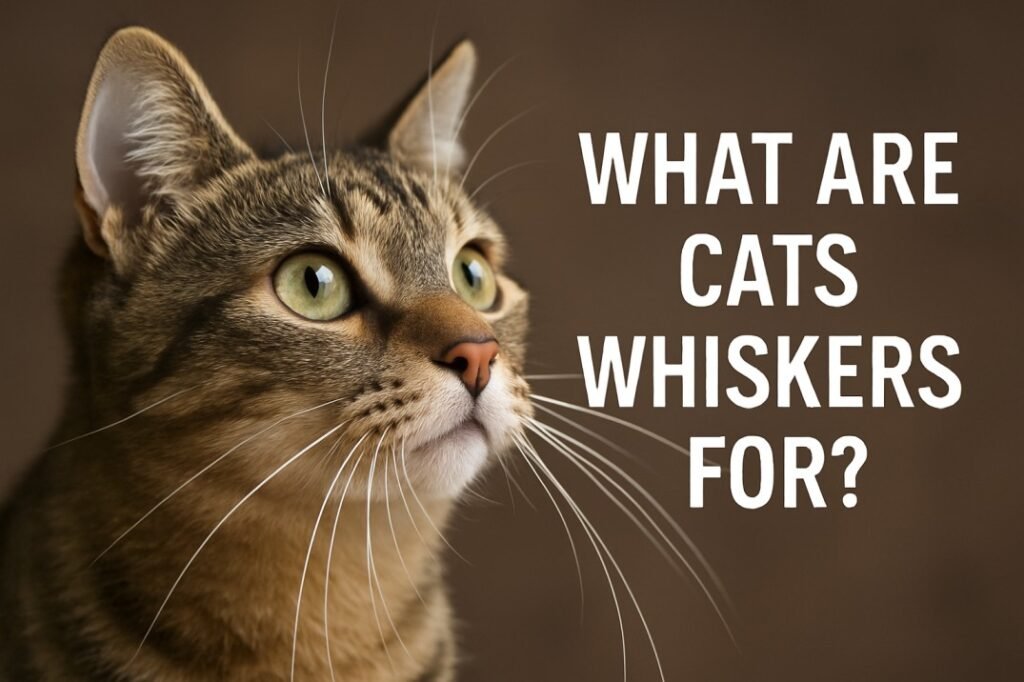

If you’ve ever taken a close look at your feline friend, you’ve probably noticed their long, delicate whiskers. These whiskers, also known as vibrissae, are much more than just adorable facial features. Many cat owners ask: what are cats whiskers for? The answer is fascinating—whiskers serve as powerful sensory tools that help cats understand and interact with their environment.
In this article, we’ll explore the purpose of whiskers, how they function, and why they’re so important for your cat’s health and daily life.
What Are Cats Whiskers
Whiskers are specialized, thickened hairs embedded deep into a cat’s skin. Unlike normal fur, whiskers are connected to a highly sensitive system of nerves and blood vessels. This makes them essential sensory organs. Whiskers can be found not only on a cat’s muzzle but also above the eyes, on the chin, and even on the back of the legs.
What Are Cats Whiskers For?
Now let’s dive into the main functions of whiskers and why your cat cannot live comfortably without them.
1. Navigation in the Dark
Whiskers act like tiny radar systems. Since cats are crepuscular animals (most active during dawn and dusk), they often need to move around in low light. Whiskers detect air currents and nearby objects, helping them navigate safely even when vision is limited.
2. Measuring Spaces
One of the most common answers to what are cats whiskers for is that they help measure whether a space is big enough to pass through. A cat’s whiskers are generally about the same width as its body. By brushing against doorways or objects, whiskers give cats a sense of whether they can squeeze through without getting stuck.
3. Hunting and Detecting Prey
Cats are natural hunters. Whiskers are incredibly useful during hunting because they detect even the slightest movement of prey. When a cat catches something, whiskers around the muzzle help pinpoint the exact location of the prey, even in complete darkness.
4. Communication and Expression
Cats also use whiskers to communicate. For example:
- Forward whiskers often indicate curiosity, excitement, or aggression.
- Relaxed whiskers mean the cat is calm.
- Pulled-back whiskers may show fear, stress, or discomfort.
By observing whisker positions, owners can better understand their cat’s mood.
5. Protecting the Face and Eyes
The whiskers above a cat’s eyes function like eyelashes. If something brushes against them, the cat will blink reflexively. This helps protect the eyes from injury. Similarly, whiskers on the chin and cheeks prevent the cat from bumping into things headfirst.
6. Balance and Orientation
While cats don’t rely on whiskers for balance in the same way they use their inner ear, whiskers still play a role in body awareness. They give feedback about how the body is positioned in space, helping cats make those graceful, acrobatic jumps we all admire.
Why You Should Never Trim a Cat’s Whiskers
Some people assume that whiskers are just like fur and can be trimmed without harm. This is a misconception. Because whiskers are deeply connected to nerves, cutting them can cause:
- Disorientation – Cats may bump into things or have trouble judging distances.
- Stress and anxiety – Losing sensory input can make cats feel unsafe.
- Difficulty hunting or playing – Whiskers are crucial for detecting motion.
Always leave whiskers untouched, even if they look long or out of place. They shed naturally on their own and grow back over time.
Whisker Fatigue: Can Cats Get Overstimulated?
A less-known issue cat owners sometimes face is whisker fatigue. Since whiskers are so sensitive, too much stimulation can overwhelm your cat’s sensory system. For example, constantly brushing against deep food bowls or water dishes may cause irritation.
Signs of whisker fatigue include:
- Refusing to eat from the bowl but eating treats off the floor.
- Pawing at food instead of eating directly.
- Acting anxious around mealtime.
Switching to a shallow, wide dish can often solve the problem.
Fun Facts About Cat Whiskers
- Whiskers are symmetrical – Each side of the face has the same number of whiskers (usually 24 on the muzzle).
- They grow with the cat – Kittens have shorter whiskers, which grow longer as the cat matures.
- Not only on the face – Whiskers also appear on the back of the forelegs, helping with climbing and catching prey.
- They shed naturally – Finding a whisker at home is normal; they regrow just like fur.
Conclusion
So, what are cats whiskers for? They are extraordinary tools that go far beyond appearance. Whiskers help cats navigate in darkness, measure spaces, hunt effectively, communicate emotions, and protect their face from harm. They are an essential part of your cat’s sensory system and should never be trimmed or tampered with.
Understanding the role of whiskers allows you to appreciate your cat’s incredible abilities and care for them more thoughtfully. Next time you see those delicate hairs twitching, you’ll know they’re hard at work helping your feline friend make sense of the world.